
Maho 26.11.0: an AI assistant in the admin, a page builder in content, media on a bucket
26.11.0 puts an assistant on every admin page, turns the content editor into a page builder, moves shared files to S3, Google Cloud or Azure and redesigns the admin on daisyUI.
26.11.0 changes three things a store owner touches every day: how you ask the admin for something, how you assemble a piece of content, and where the files live. Around them comes the rest, including a redesigned admin, product page gallery layouts and the move to PHP 8.5. It is also the first release that ships alongside Maho Admin, the native app for running the store from a phone or a tablet, now on Google Play.
Maho Admin, the store in your pocket
26.11.0 is the first release that works with Maho Admin, the official app for iPhone, iPad and Android. The app talks straight to the store: no server of ours in the middle and no tracking. It shows sales, orders, bestsellers and visitors for every website and store view, and it is there to ship an order from the warehouse or fix a price on the train. It is on Google Play, it reaches the App Store soon, and the subscription is 9.99 € a month for one instance, with all its websites and store views.
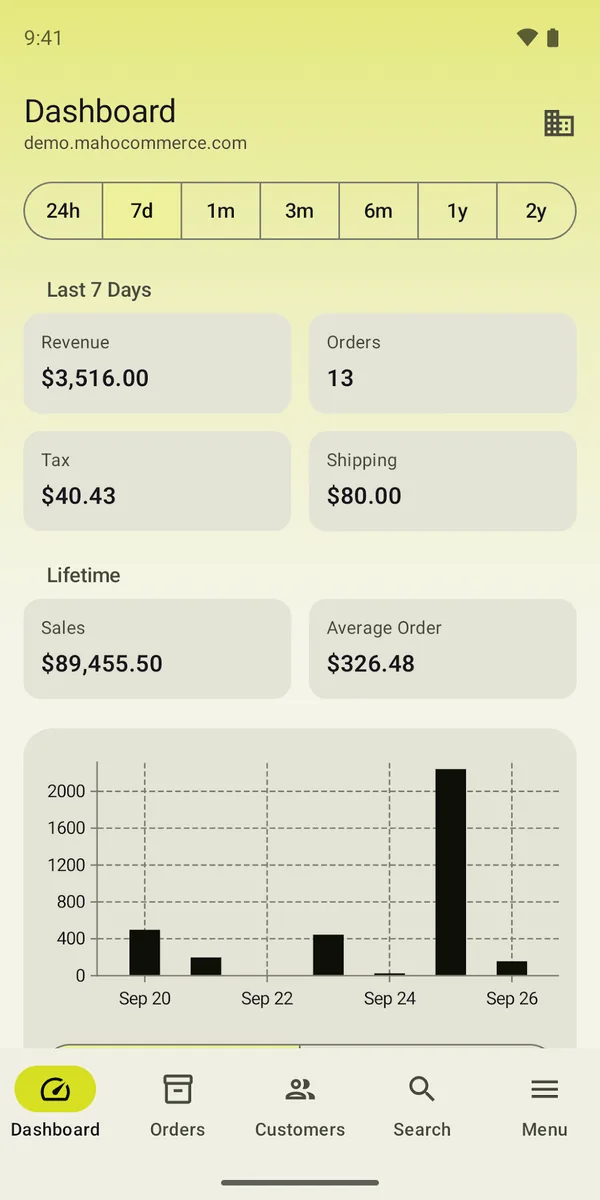
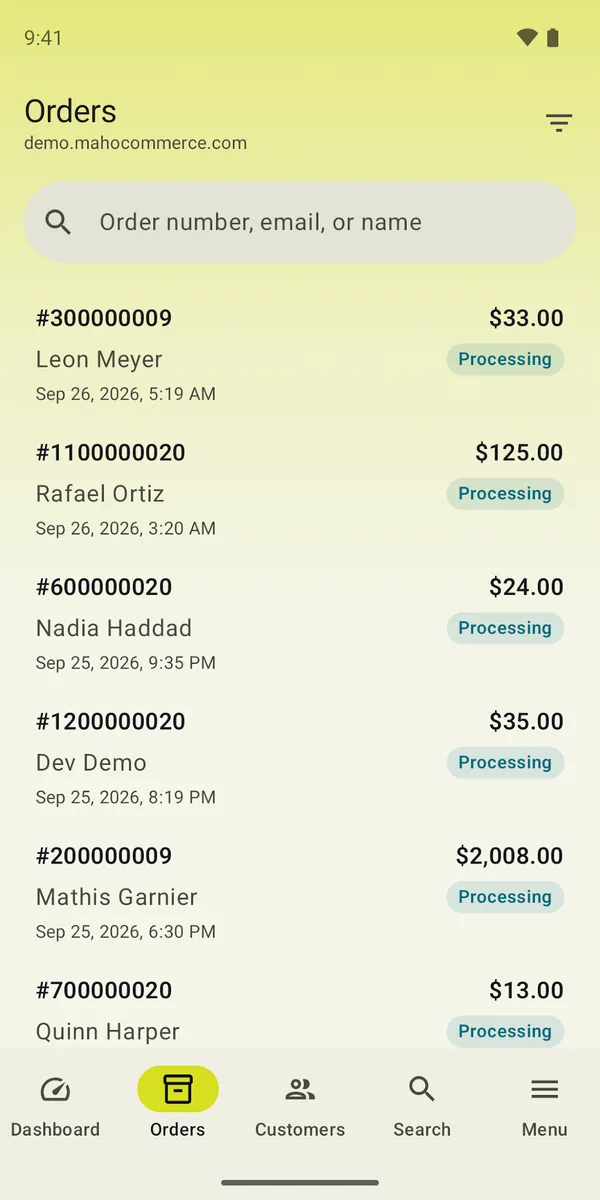
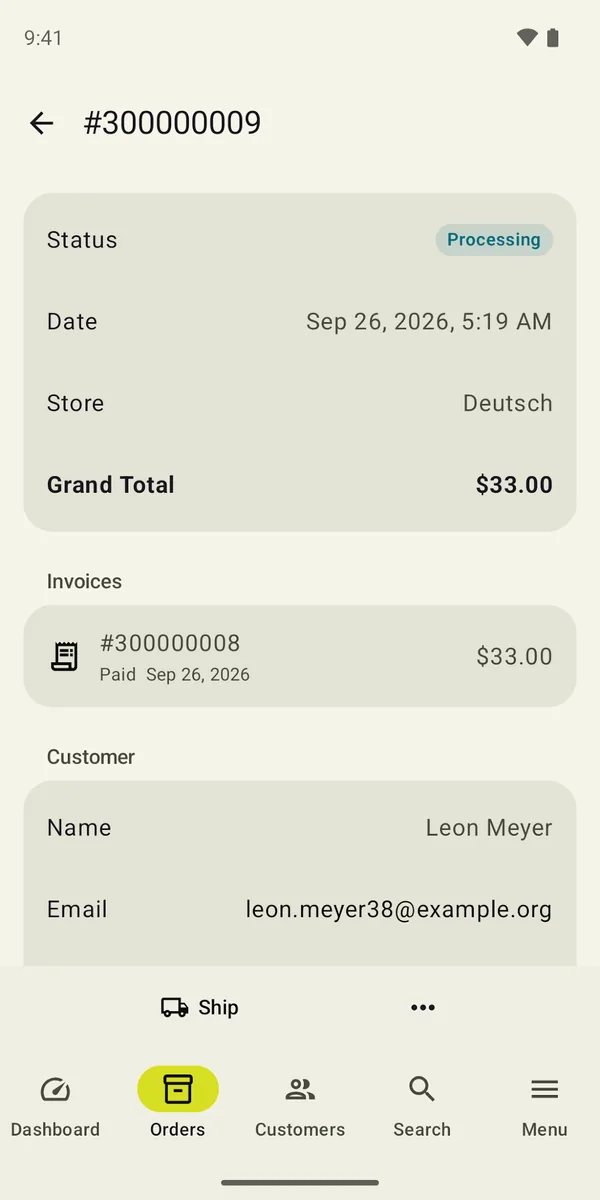
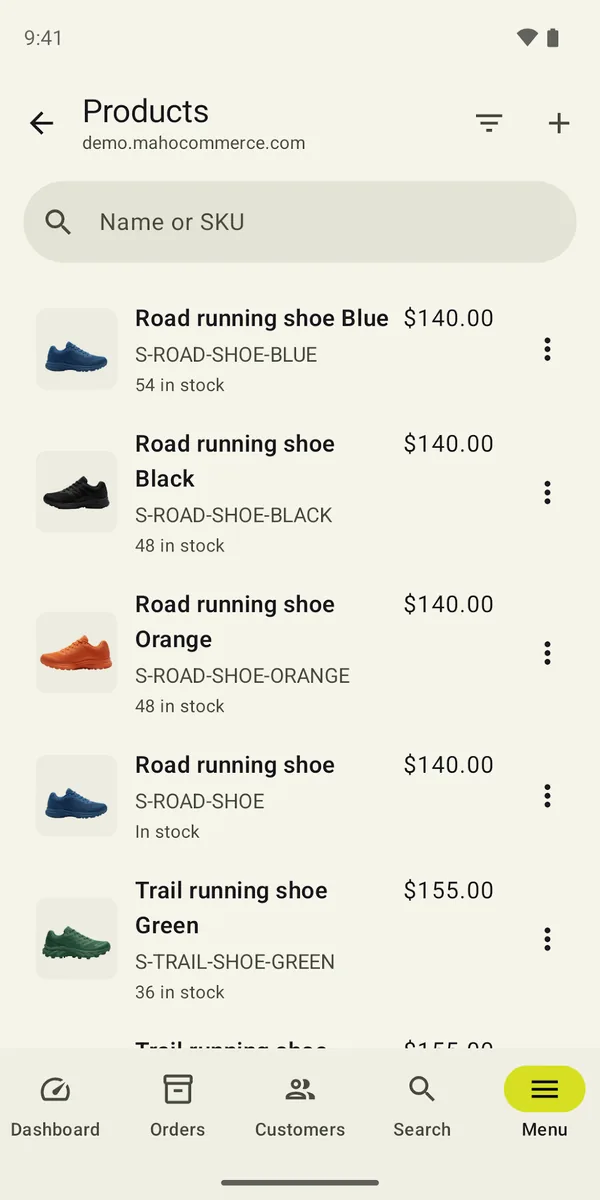
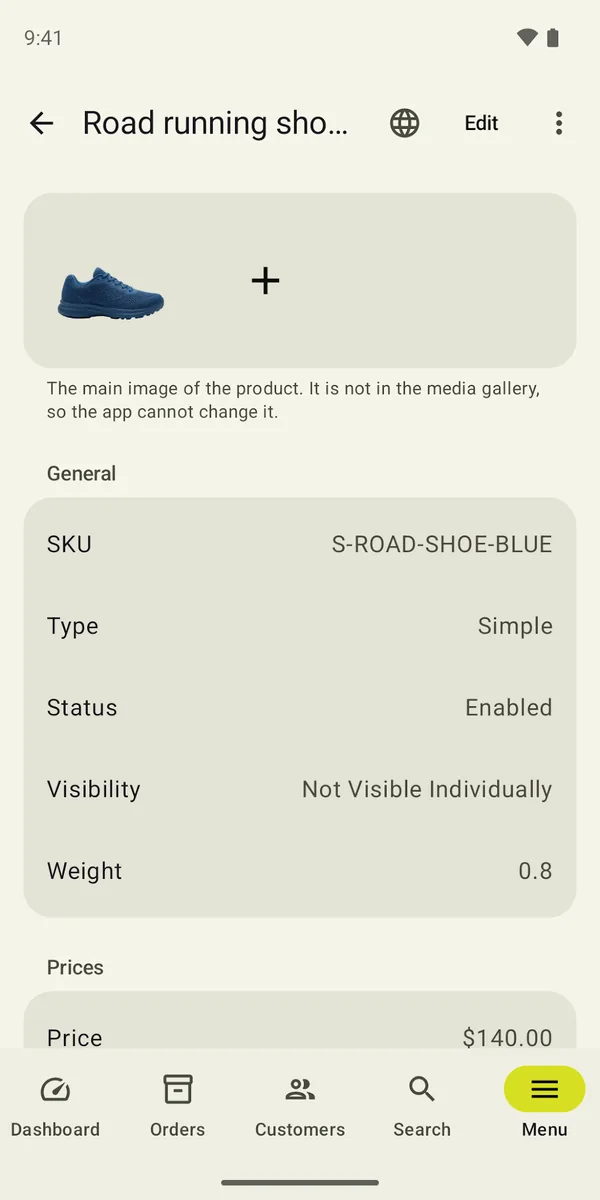
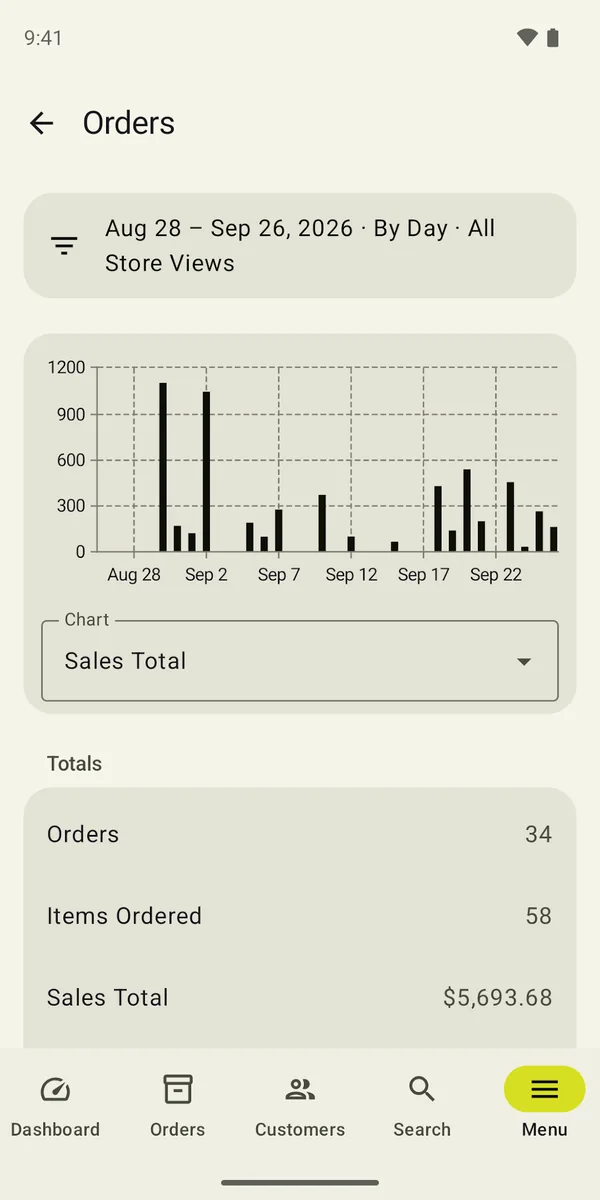

The connection uses the same OAuth flow as the MCP clients, and the new Connect Applications permission lets an administrator approve the app without the power to revoke the connections of every other administrator. Each admin sees and disconnects their own applications under System > My Account, and the OAuth consent page works on a phone.
An assistant on every admin page
An admin user opens a panel with Option+A or Alt+A and asks in plain language. The assistant reads the store through the same tools the MCP server exposes, answers with links to the records and, on a record page, fills the open form without saving it. Every write waits for a confirmation with the value before and after, and a confirmed change can be undone.
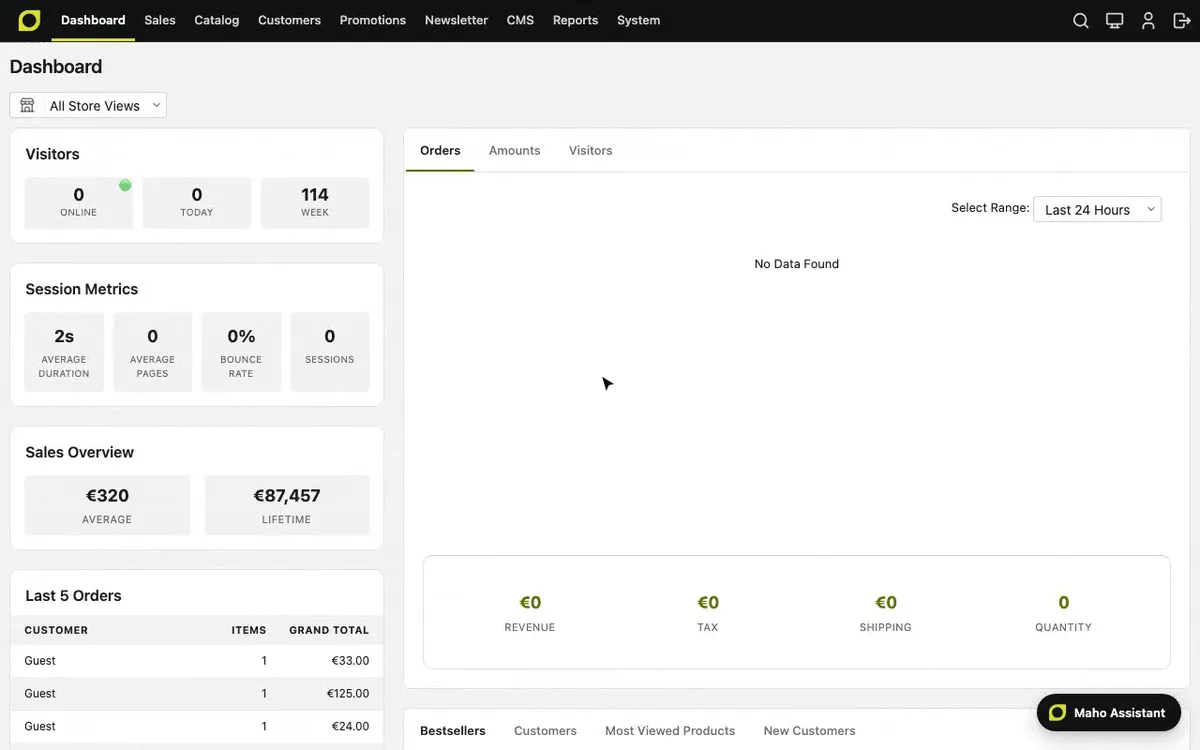
The panel is off by default and turns on in System > Configuration > AI >
Assistant > Enable Admin Assistant. It needs a configured AI provider and the
system/ai/chat ACL resource, and conversations belong to one administrator. You
give a recurring instruction in System > AI > Assistant Scheduled Tasks, with
a cron expression in the store time zone and an audience for the result, which
lands in the admin inbox. System > AI > Assistant Actions Log lists every
write the assistant ran, denied or failed.
On answer quality the release carries a measurement: over 49 questions about swatches, catalog rules, settings and orders, Haiku 5.5 goes from 49% to 78% correct or honest answers, and Sonnet 5.5 from 76% to 94%. It helps that the user guide, the developer, API and hosting docs now live in the repository next to the modules, so each store reads the pages of its own release.
The full picture, with the tools, the limits and the confirmation rules, is in the deep dive on the admin assistant.
A page builder for content
The Content tab of CMS pages, CMS blocks and blog posts opens fullscreen as a page builder: a blocks pane on the left, the content in the middle, a storefront preview on the right. The preview is a draft the server renders in the theme of the selected store view, so it shows content that is not saved yet.
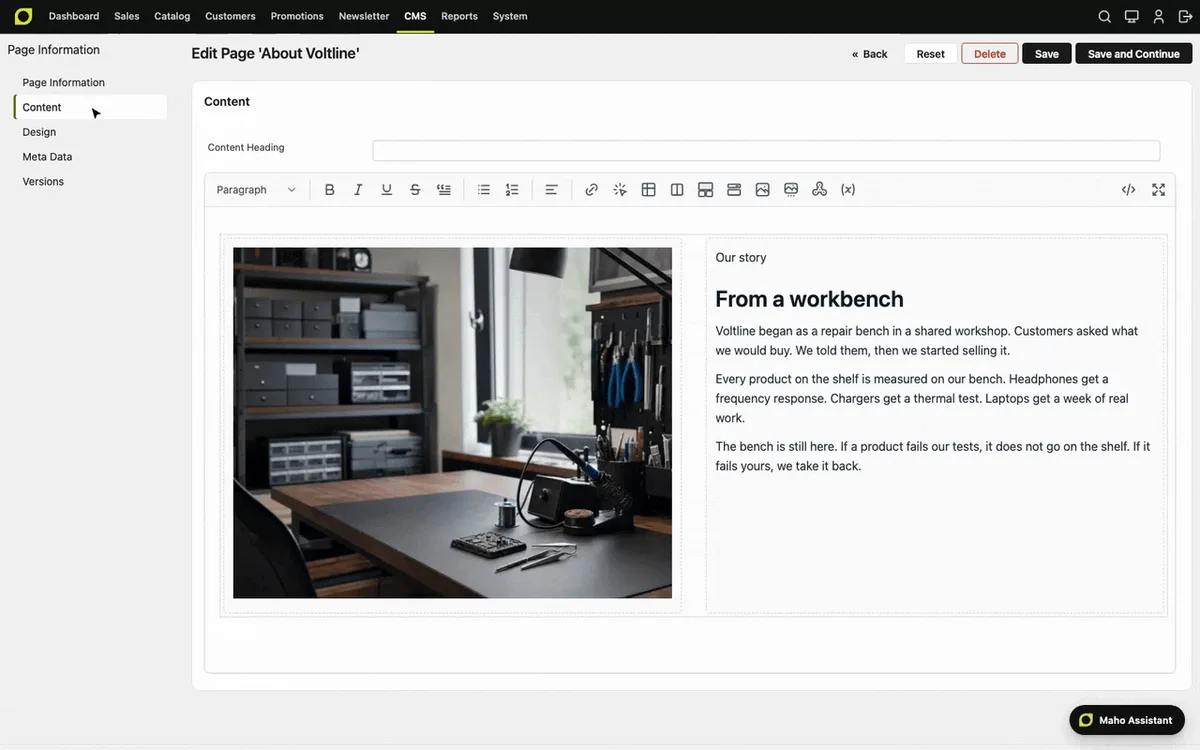
The same work makes the editor render widgets and blocks as a visitor sees them, a
Source button opens the HTML in a code editor that completes the classes of
the theme and shows their CSS, and the Tailwind or daisyUI classes typed in
content reach the storefront stylesheet. A save queues the build, and
./maho theme:content:build runs it in a deploy.
MageMEGA was part of the process and started the idea with a proof of concept
(discussion #1572, a standalone module with no core patches), later merged into
the core as the Design Mode of empiricompany/maho-design-mode. How it works, the
limits of the preview and what survives a save are in the deep dive on the
page builder.
Media on S3, Google Cloud or Azure
A store can now run on several web servers with no shared disk. Every file the
nodes must read, media, customer uploads, downloadable products, sitemaps, feeds
and import and export files, goes through a named storage mount, and
app/etc/local.xml points each mount at S3 or an S3-compatible store, Google
Cloud Storage or Azure Blob Storage. A single server with a local disk keeps the
same paths and the same URLs, and it gains something too: the catalog images take
no disk on the host, and the storage serves the files through its public URL or
through the CDN in front of it.
Three commands take the busywork: ./maho storage:migrate copies the existing
files to the bucket, ./maho storage:image:resize creates the resized images
ahead of the first visitor and ./maho storage:image:clean deletes the sizes no
template uses.
A private mount, such as a file a customer uploaded or a paid download, has its own space and never lands in the public media bucket. The paths and the options are in the deep dive on media on a bucket.
A redesigned admin on daisyUI
Buttons, form controls, checkboxes, messages, status labels, boxes, tabs, the main
menu and the data grids now use daisyUI 5 components at a dense admin size, in
light and dark mode. The admin skin has its own Tailwind CSS 4 and daisyUI 5
build, like the storefront, compiled with ./maho dev:admin:theme:build. The
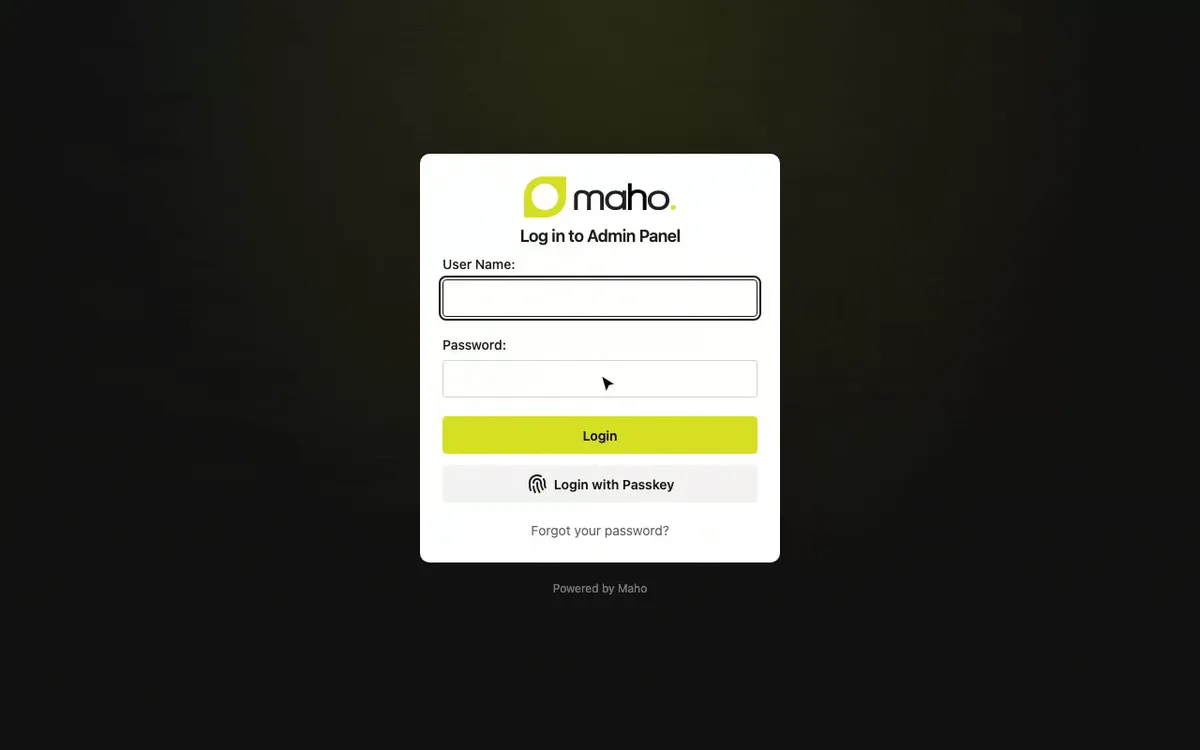
login, forgot password, reset password and OAuth consent pages are new and fit a
phone screen: the login page puts the Log with Passkey button under the
credentials, and an admin who registered a passkey signs in without typing the
password.
On the product page the images are cards with a toggle for each role and they reorder by dragging, from the keyboard too. Button labels are short and consistent: Save, Delete, Add, Submit, Save and Continue.
Gallery, images and the fixes you can see
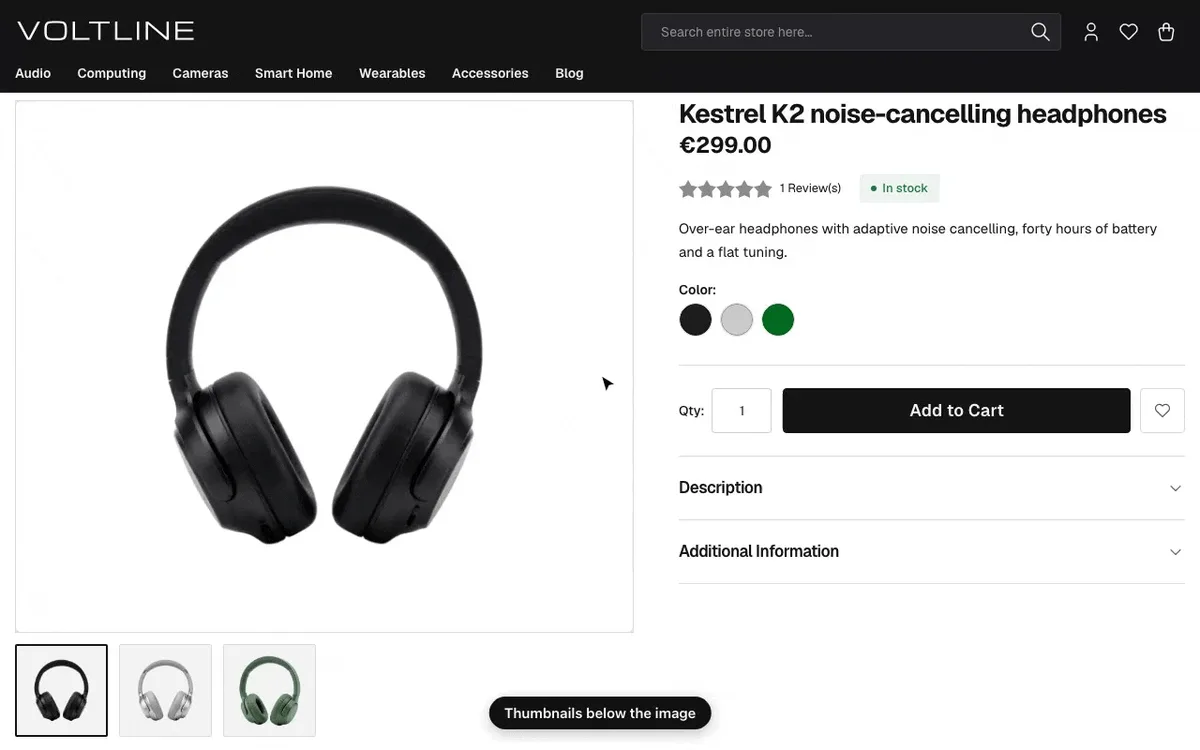
The product page gallery has layouts with thumbnails below, left or right of the image, or a grid of every image in one, two or three columns, in System > Configuration > Design > Product Page Gallery. On a phone it is a swipe carousel with a counter, and “Phone Layout” brings back the previous layout.
In the same line of work, a product has a single Main Image: Small Image and
Thumbnail only picked a size, and templates now name a slot
(getImgAttributes('listing')) that writes src, srcset, sizes, width and
height. The resized files of products, categories, blog posts and swatches are
created on the queue at save time, so categories and the blog no longer serve
images at their original size.
The image editor: upscale and adjustments
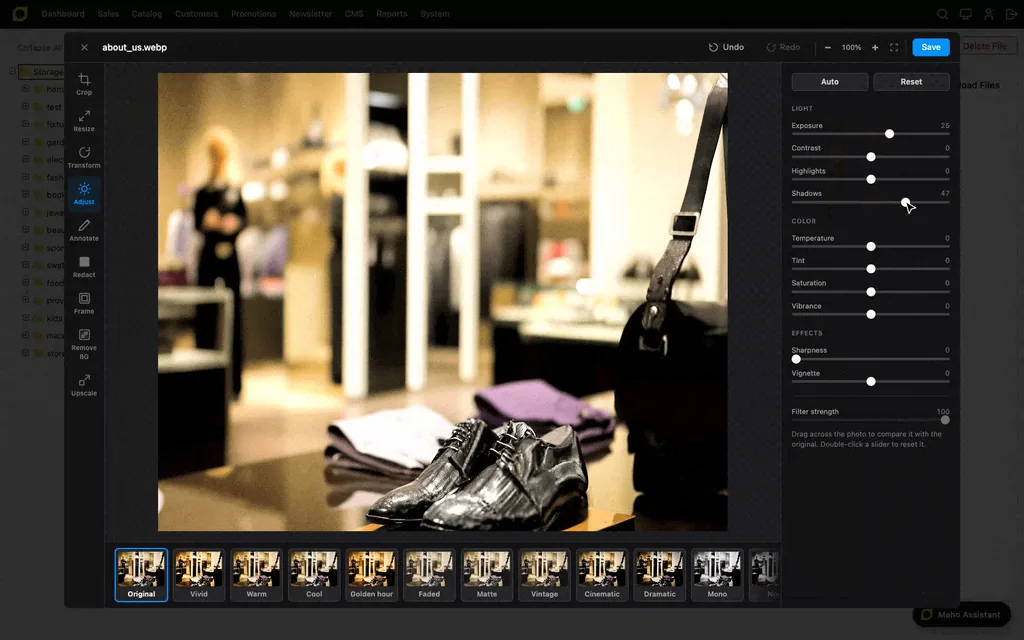
The admin image editor takes two new tools. Adjust brings ten sliders split into three groups, light, colour and effects, thirteen ready filters and a compare line to drag across the photo, which shows the original and the result in the same spot. Hue and Warmth are replaced by Temperature and Tint, that is a real white balance, the one you need when the product photo was shot in a room with the wrong light. Upscale enlarges the image up to four times, for the files a supplier sends at 256 pixels that on the product page would look blurry. You pick 2× or 4×, and the model runs in a web worker inside the browser, on the graphics card when there is one and on the processor otherwise: the photo is never sent to a service, so an image that must not leave the store can pass through here too. It works on images up to 1024 pixels on the long side, past that resize it first.
The tool options moved into a panel on the right of the photo, and the user guide has a page dedicated to the editor.
Across the rest of the release:
- a full reindex three to five times faster (#1582): on the sample data store
with 1,040 products and 15 store views,
index:reindex:allgoes from 5.2 s to 0.95 s on SQLite, from 4.54 s to 1.63 s on MySQL and from 5.58 s to 1.09 s on PostgreSQL. Independent indexes run in parallel, and a URL rewrite rebuild sends 545 queries instead of 17,079; - custom lines in admin order creation (#1577), for an installation fee, a deposit or a made-to-order piece, with a free name, price, tax class and weight, that then behaves like any other line through tax, invoice, shipment, credit memo and order edit;
- postcode and region validation per country in checkout, the address book, registration and the admin forms (#1481), with the country as the first field and an example postcode as the placeholder;
- a deleted product answers 410 instead of 404 (#1444), and the store remembers those URLs for 365 days by default;
- a limit on the layered navigation filters a visitor can select (#1705): past Maximum Selected Filters, 7 by default, the page answers 404 before the products load;
- long admin actions run in the background (#1675): product relationship rules, exports and imports, with the result in System > Notifications.
The foundation moves up a major version
Maho now requires PHP 8.5.1, runs on Symfony 8.1 and on API Platform
5.0, and every terminal command is a Symfony Console invokable command with its
arguments and options declared on __invoke(). The SVG sanitizer is rebuilt on
the PHP 8.5 DOM and the WHATWG URL parser, so it reads each link the way a browser
does.
On the API side, clients can search products with the HTTP QUERY method (RFC
10008) on /api/products, with the filters in a JSON body, and a Scalar API
Reference is at /api/docs?ui=scalar, next to Swagger UI and ReDoc. The admin
API covers most of the daily work: orders, invoices, shipments, credit memos and
customers are searched like the admin grids do, cart price rules come with their
conditions and coupons, and reports and the global search are readable from a
client.
Two things leave the core: the flat catalog, with its two settings, two
rebuild buttons and two indexers, and recurring profiles, which no payment
method could process since the legacy PayPal module went away. The
catalog_*_flat_* tables stay in the database and can be dropped by hand to free
the space.
On security, every storefront action that changes data checks the form key,
session messages are always escaped, downloads and the editor no longer reach
files outside their folder, and every release ships maho-<version>.zip with its
CycloneDX SBOM and signed build provenance, verifiable with gh attestation verify.
What to know before updating
The upgrade guide of the release is long, because this is a major. These are the points to plan for.
- PHP 8.5.1 first, then Maho. On an older PHP,
./mahoand the store stop with a Composer platform error. - The Composer constraints: Symfony
^8.1,api-platform/core^5.0,doctrine/dbal^4.5,mahocommerce/maho-composer-plugin^5.2. Andsymfony/mcp-bundleandnyholm/psr7are now required packages. - A database backup, because two upgrades delete data with no way back: Catalog 2.0.2 copies Small Image, then Thumbnail, into an empty Base Image, now called Main Image, and deletes the two attributes with their values; Sales 2.0.3 drops the recurring profile tables. Orders stay.
./maho migrateconverts every MySQL and MariaDB table to utf8mb4, third party ones included. A large store needs a maintenance window:./maho migrate --dry-runshows the list first. Delete<initStatements>SET NAMES utf8</initStatements>fromapp/etc/local.xml, which Maho now ignores.- A new nginx rule for resized images, the one in the web server guide. After
the deploy, run
./maho storage:image:resizeonce and flush the full page cache; on a bucket, do it before the store opens. Every resized image gets a new URL, and the cleanup deletes the old files, so old URLs in sent emails stop working. - Cron and the queue workers must run: image resizes, exports, imports,
catalog rules and statistics refreshes go through the queue. A store with
Maho_Queuedisabled stops at load, and an export is no longer a download: the notification links the file. - Every storefront POST needs a form key. A payment notification, webhook or
gateway return must be listed in
$_publicActions, each POST form in a theme renders<?= $this->getBlockHtml('formkey') ?>and JavaScript POSTs usemahoFetch()../maho health-checklists the templates with a POST form and no key. - The browser runtime: run
./maho sys:playwright:installonce, or the admin accessibility scan fails. - A store that turned MCP on before the packages were installed now has a live
endpoint at
/api/mcp: check the toggle and MCP Requires Authentication. - With “Use Categories Path for Product URLs” at No, the category URLs of products become 301 redirects at the next reindex.
- For extension developers, the typed accessors on every
Mage_*model, the files that now declarestrict_typesand the commands rewritten on__invoke()are the three changes that break an override without the right types. - The Connect Applications permission: approving an OAuth connection now needs
the
api_connectresource. The upgrade copies the rule of each existing role, but a role created afterwards needs it.
How to update
The path is the usual one, and the 26.11.0 upgrade guide is worth keeping open
while you work. Before touching production, try it on a copy, update PHP, check
that cron and the queue workers run, and check that the theme does not copy the
templates the guide lists, from sales/order/history.phtml to
catalog/product/helper/gallery.phtml.
Text prepared with the help of AI and checked against the source before publication. It can still contain mistakes: if you find one, report it.Read the manifesto
Source: Release 26.11.0
Does your store still sell?
Tell us where you are starting from: we reply with a first assessment, no strings attached.
Ask for the store assessment