
When the one reading the store is an AI
Since 26.9 Maho can be used by AI agents (MCP server, 201 tools, OAuth login) and read by them with robots.txt, llms.txt and markdown.
Artificial intelligence reaches a store from two opposite directions, and 26.9 covers both. On one side there is an agent that acts: it walks into the backend, reads stock levels, creates an order, works for an authenticated customer. On the other there is an assistant that reads and cites: it answers a question about a product and mentions the store, without ever signing in. Two trades with different permissions, different risks and different knobs, and in Maho they come with separate tools.
An agent that walks in and works
The MCP server is the door through which a client with tool calling, so Claude, ChatGPT or an editor, talks to the backend. It is switched on under System > Configuration > Services > API, because it is a protocol like the others, and it is switched off like the others.
Access is designed for a person in front of a browser: paste the store URL into the client, the agent takes you to the panel, you sign in and approve the connection. It is OAuth 2.1 with a browser login, so there are no keys to paste into a config file and no token left behind in a chat history.
What matters for maintenance is something else: the tools are not written by hand, they are derived from
the same ApiResource metadata that drives REST and GraphQL. A default install exposes 201 tools,
from catalog_products_list to sales_orders_get, and every third party resource that declares its API
becomes a set of tools with no extra work. A call runs the same pipeline as the matching REST request:
security expressions, role permissions, admin ACL, write logging and rate limiting.
# the protocol packages are optional dependencies,
# install them only when MCP is on
composer require <mcp-packages>
For the agent this means the store is not one monolithic block: it can be given a role with just the permissions it needs, and its writes stay in the same log as the actions of a human.
A store that makes itself readable
The other direction is visibility. Nobody writes here: a crawler reads, and the question is what you let it read and what you want it to repeat. The configuration sits under Catalog > Crawlers & robots.txt, with two groups, robots.txt and llms.txt.
Maho served no robots.txt at all. Now it generates one per domain, with RFC 9309 handled properly: the
base rules are repeated inside every named group, because a User-agent: GPTBot group inherits nothing
from the wildcard one, and without the repetition you end up exposing everything to the very crawler you
meant to limit. Rules that name the admin path are dropped, so the backend route stays private.
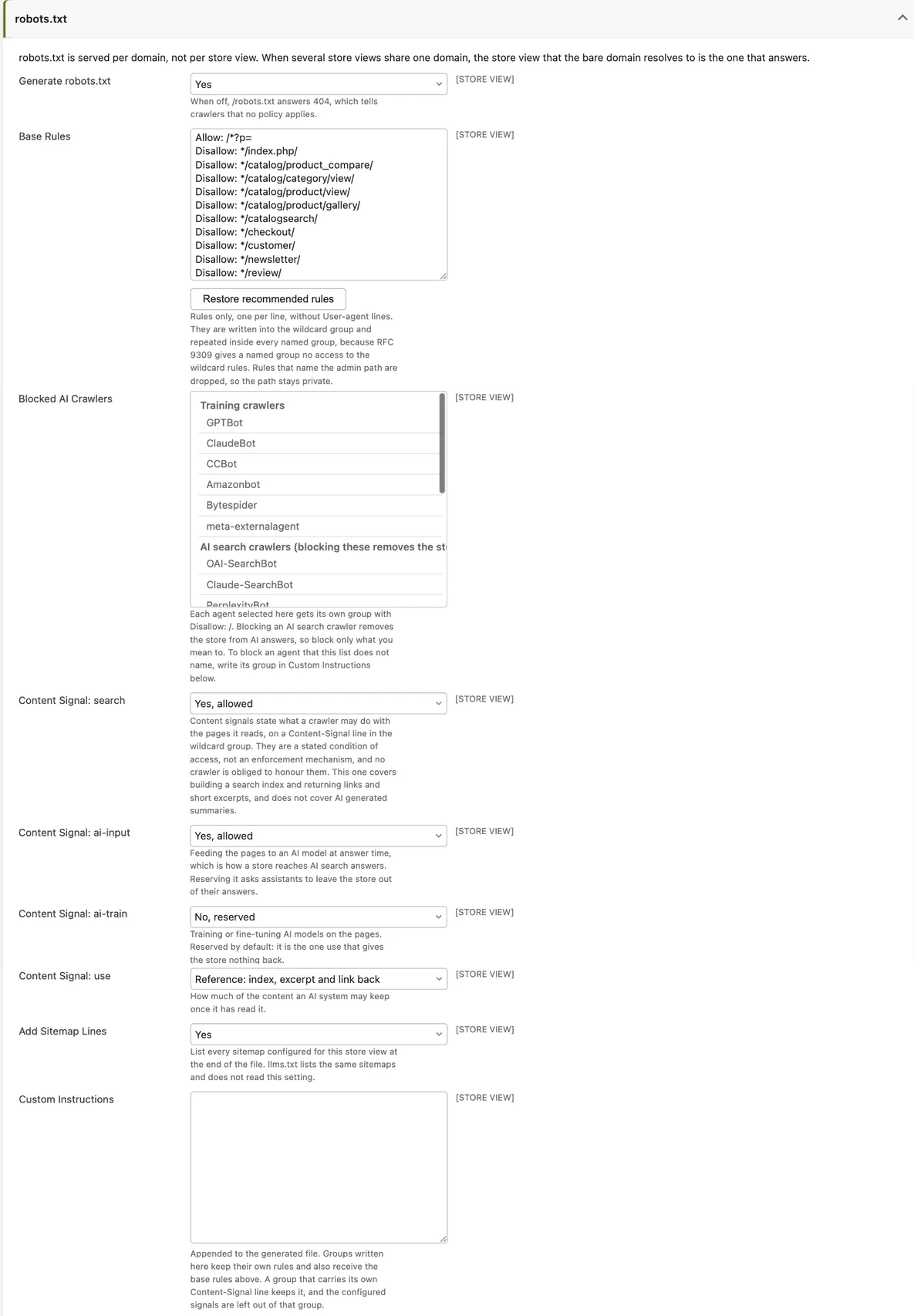
The base rules start from a sensible list, and a button restores the recommended ones after somebody
edited them. Switch the generation off and /robots.txt answers 404, leaving every crawler without a
policy, which is almost never what you want.
In the blocked agent list the choice needs care, because agents are grouped by purpose: stopping the bots
that train models does not remove the store from answers, stopping the AI search ones does. Next to it sit
the Content Signals, four lines stating what a crawler may do with the pages it reads: search,
ai-input (handing the page to a model at answer time, the road into an AI answer), ai-train and use.
They are not a technical filter, they are a stated condition of access, and the prudent default is already
there: ai-train reserved, because it is the only use that gives the store nothing back.
Then comes what agents actually need in order to understand: llms.txt as a markdown index of the store,
with name, description, locale, currency, CMS pages, posts, top level categories, the search URL and the
sitemaps, plus a markdown block you edit in the admin, and llms-full.txt when the full text is needed.
Markdown is the part that gets you cited
This is the piece that weighs most on GEO and AEO, meaning on the chance an assistant cites the store in an answer. The reason is simple and worth stating plainly: when an agent reads a product page as HTML it pays for the navigation, the scripts, the styles and the tracking code before it reaches the price, and it pays in tokens. Most of that budget goes into noise, and the agent still has to guess which part of the page is the price.
Since 26.9 the same URL answers in markdown when an agent asks for it. The Accept: text/markdown header is
enough, and it is what Claude Code sends by default, or .md at the end of the path: /women/ becomes
/women.md and lafayette-dress.html becomes lafayette-dress.html.md. Both routes answer the same
document, and browsers and search engines keep receiving the HTML page they always got.
The markdown is not a copy of the page, it is the page rewritten for a reader that wants facts:
- a product carries name, SKU, price (with the regular price when a special price applies), availability, brand, GTIN, image URLs, description, the attribute table and one row per option of a configurable or grouped product, with its own price and availability;
- a category carries the description and the first hundred products as a table with link, SKU, price and availability, and points to the XML sitemap for the rest;
- CMS pages and blog posts carry the title and the content converted to markdown, with template directives resolved.
Why this improves citations: a table of products with SKU, price and availability is an answer already
prepared, and an assistant that finds the answer prepared cites it far more readily than one that has to
rebuild it from a tree of div elements. Less ambiguity means fewer mistakes when reporting the price, and
a correctly reported price is the difference between a useful citation and one the customer finds wrong at
checkout.
Every HTML page announces its markdown version with a Link: rel="alternate" header, the markdown response
is noindex so search engines never see a duplicate, and the output is cached per store view and currency.
Markdown pages are on by default for catalog, CMS and blog, and can be restricted by route or switched off
from the same configuration section.
⭐ A starry note: this is where you see the effect of something that looks like a technical detail. Markdown does not change what the customer sees on the site: it changes what the assistant manages to tell about the site when the customer is not there.
Where the two directions meet
The temptation is to think one of them is enough, and the shortcuts always land in the same place:
assuming a robots.txt protects an API, or thinking an MCP server helps you get found by search engines.
They are different trades: one is an authorisation problem, the other a publication one.
The meeting point is the content. An agent that buys needs to know what the store sells, so it needs titles, attributes, availability and readable images. An assistant that cites needs the same data in the right shape. A catalog whose descriptions are three lines copied from the supplier works in neither case, and no configuration saves it.
⭐ A starry note: all of this turns on the same thing. AI does not read your site the way a person does, and everything you are preparing here is, in practice, a well written catalog with the right labels.
What to do now
- Turn MCP on only for a concrete use, with a dedicated role carrying the minimum permissions.
- Read the generated robots.txt and check the base rules before touching the agent list.
- Choose the Content Signals according to what you want AI to do with your content, not by reflex.
- Open the markdown pages on catalog, CMS and blog and check a product with variants.
- Read
llms.txtthe way an agent would: if the category list is not what you want to show, fix it in the admin.
The rest takes time: AI answers are built on the indexing that exists and on the trust a store earns, and neither of those comes with a switch.
Text prepared with the help of AI and checked against the source before publication. It can still contain mistakes: if you find one, report it.Read the manifesto
Does your store still sell?
Tell us where you are starting from: we reply with a first assessment, no strings attached.
Ask for the store assessment